Roads and passes
Who grits the road: what changes when you turn off the A82
The trunk roads get a gritting service around the clock until May. The council roads our days turn onto get one from six in the morning to nine at night. Here is where that line falls on Glen Etive and Applecross.
Roads and passes
Since 1 October every trunk road in Scotland has had a 24-hour winter maintenance service, and it runs until 15 May. That is Transport Scotland’s commitment, and in the Highlands it covers the A82 through Glen Coe, the A87 to Skye, the A830 to Mallaig, the A835 to Ullapool and the A887 through Glenmoriston.
The roads our days actually turn onto are a different arrangement entirely. They belong to Highland Council, whose winter service runs from mid-October to mid-April, from six in the morning until nine at night, seven days a week. The council’s own leaflet puts it in capitals: it does NOT operate a 24-hour service. There is no overnight treatment at all, and after six in the evening only primary routes are done.
None of that is a criticism. It is simply worth knowing which kind of road you are on, because a day can start on one and end on the other.
Two networks, two sets of rules
The trunk roads in the north-west are looked after for Transport Scotland by BEAR Scotland. Last October it put its North West fleet at 59 winter vehicles working 1,422 kilometres of trunk road from thirteen depots, with 35,000 tonnes of salt in stock. Those are the 2025 figures; this winter’s announcement had not appeared when this was written. Gritters treat ahead of forecast frost, patrols go out to plough and salt as needed, and Transport Scotland runs a public tracker showing where the gritters are.
Off the trunk road, the council sorts its own network into three. Primary routes — most A-class roads, some B roads, the main commuter routes — are treated between six and nine. Secondary routes, the roads that connect smaller places to the primary network, are done mostly after the primaries are finished, between six in the morning and six at night. Other roads, the minor rural and access roads, are treated “as resources become available”.
The scale of that last category is easy to underestimate. In Lochaber, 395 of the council’s 681 kilometres of winter network are classed as other — 58 per cent — and the area has eight gritters to cover the lot, each doing about fifty kilometres of primary and secondary road before it gets to the rest.
Glen Etive and Applecross on this winter’s maps
The council publishes a route map for each area every year, and the 2026/27 editions are out. Two of our days cross the line between the networks, and the maps show exactly where.
Glen Coe and Glen Etive. The A82 is trunk road, gritted around the clock. The twelve miles down Glen Etive are council road, and on the Lochaber map they carry no colour at all — neither primary nor secondary, which puts them in the “other” category. That fits what the Glen Etive day page already says about the road in snow, and it is the reason a winter version of that day is a Glen Coe day with Glen Etive as a possibility rather than a promise.
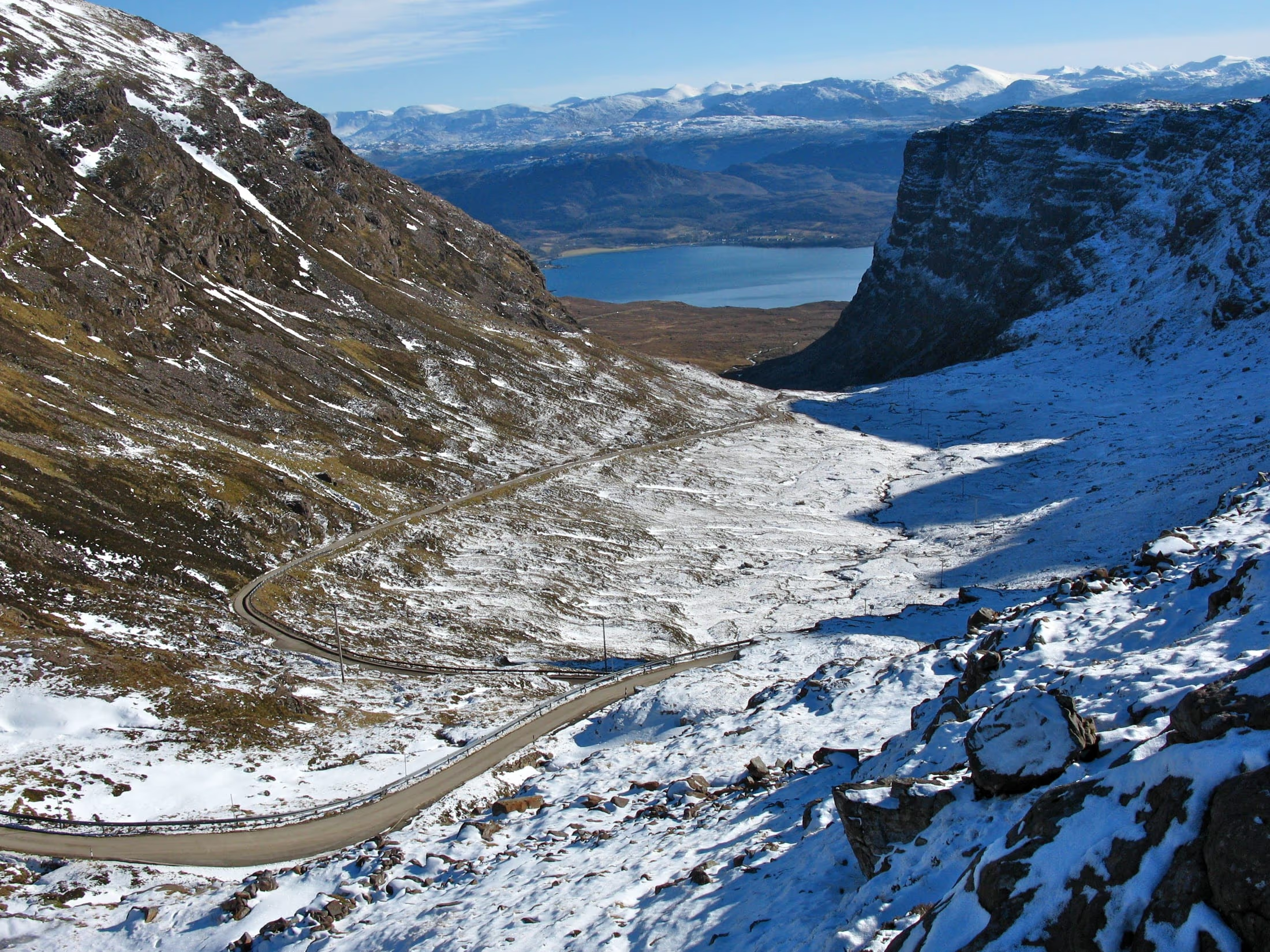
Applecross. The A896 round Loch Carron to Shieldaig and Torridon is marked primary on the Ross and Cromarty map. The Bealach na Bà is marked secondary — and so is the coast road round the peninsula from Applecross to Shieldaig. They sit in the same gritting category. So when the coast road is the better winter choice, as it often is, the reason is not that somebody salts it sooner. It is that the coast road keeps close to the sea, and the pass does not.
Salt is not the same as safe
The most useful line in the council’s leaflet is not about routes at all. Salt, it says, will not stop roads icing in extreme conditions, and that is particularly true on low-traffic roads, because salt needs passing vehicles to work it into the ice. Glen Etive and the Bealach are about as low-traffic as public roads get in winter. A treated road with nobody on it can still be an icy one.
The leaflet makes two further points. Black ice is invisible and can remain after treatment. And dawn frost catches people out: under a clear sky at first light, heat leaves the road surface fast, and a wet road can turn icy in patches just as the day starts. The leaflet’s last line is the one to keep — black roads do not mean ice-free roads. The photograph above is a fair illustration: tarmac clear and dark, and nothing either side of it but snow.
Transport Scotland is equally plain about its own network: even with the 24-hour service, there will be times when trunk roads are not completely free of snow and ice.
What this means for a winter day
In practice it means the plan for a December day is written around the trunk road and the council map, and the decision about the last few miles is made on the morning, from what the roads are actually doing. Traffic Scotland covers the trunk roads live. For council roads the honest answer is to look, and to turn round if it is not right.
All of the above is how the service is set out for 2026/27 at the time of writing. None of it says whether any particular road is clear on any particular day — no map can.
Where this came from
- Transport Scotland — winter service on the trunk road network
- BEAR Scotland — North West roads ready for winter (27 October 2025)
- Highland Council — our road gritting priorities
- Highland Council — Ross and Cromarty winter route map 2026/27 (PDF)
- Highland Council — Lochaber winter route map 2026/27 (PDF)
- Highland Council — Lochaber Winter Service Plan 2026/27 (20 July 2026, PDF)
Conditions in the Highlands change quickly, and a road that was open when this was written may not be today. Check the source before you plan around anything here — or ask us, because we will be driving it.
Days this touches